

You built an AI meeting notetaker, and next week Google added Gemini to every Meet call, for free.
You built an AI agent to increase productivity of sales teams embedded in Slack, and next week Anthropic released Claude tag.
Or you built an app to learn touch typing, and next month Wispr Flow made everyone talk, not type.
You see where I’m going? The value chain is shifting. It’s no longer enough to build a thin layer on top of GPT and call it a product. With AI in our hands, product development has gotten muuuch faster. But that speed is available to everyone, including the handful of companies that own the LLMs themselves, allowing them to concentrate on the value of ~all AI-based products. For example:
I could buy a fancy app to track my nutrition information OR I could simply start a new chat or project in Claude(GPT) and start tracking there. Yes, I’ll lose some UI polish, sure. But the job gets done — sometimes with more flexibility than a dedicated app would give me.
So, in a world where everyone can build everything, and do so fast, careful roadmap prioritization is no longer relevant: it’s sometimes faster to ship, test, and watch the metrics than to run a full impact-evaluation exercise. Then what are the next frontier problems in product development?
Distribution
I’ve been loud about this one for a while. Human attention is a finite resource, and an increasing number of players are competing for it.
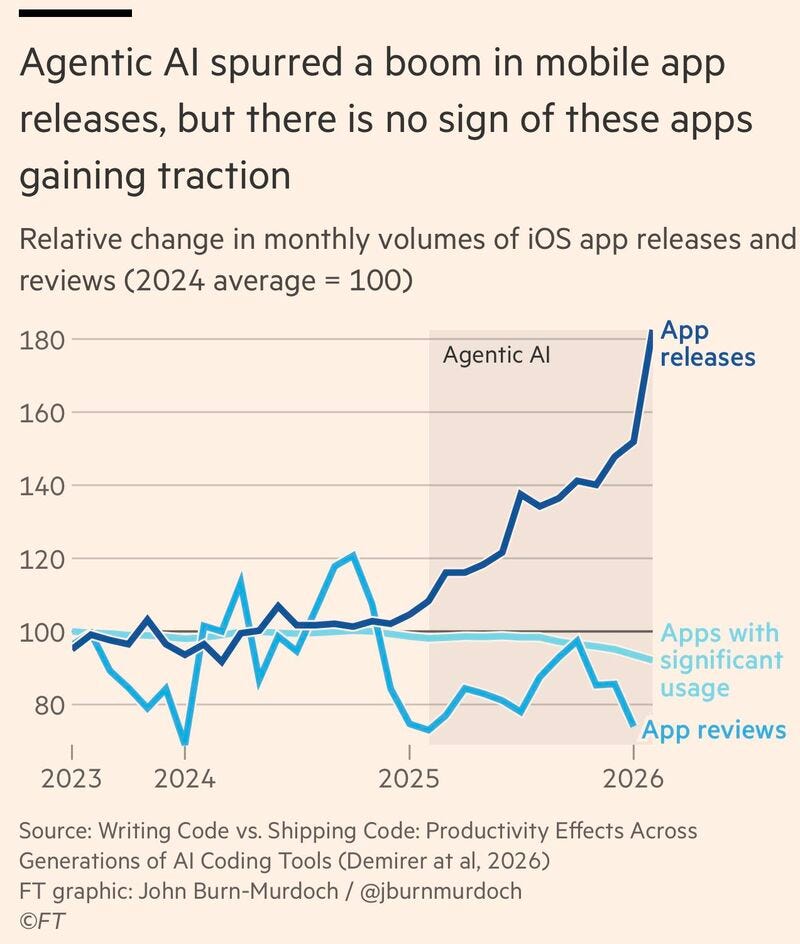
A widely cited Financial Times chart by John Burn-Murdoch shows that while AI-assisted coding drove an 80% surge in iOS app releases, the number of apps with significant user engagement remained flat.
When anyone can lovable their own app, the development itself becomes a low-cost component of the business; the real value moves to distribution - the ability to actually reach the people who need what you built. And that’s exactly where most builders get stuck. Their value props are AI-generated, which means they’re flat, generic, and forgettable. If you’re working on distribution, the channel matters less than you think — your customers are already on social platforms, your competitors are too. So you main job now is to give a reason to stop scrolling.
Judgement
Caused by the same thing — low cost of development 1 — the next problem is judgement.
We live in a world where you can ship faster than your A/B test needs to reach significance (Elena Verna wrote a really good post on this, worth reading). The customer asks for a feature on Monday, it’s live by Wednesday. Another one asks Thursday, shipped Friday. Just last week, my eng team received feedback from one regular customer, and shipped a feature while I was on a day off. Every request can be addressed. But “can be addressed” and “should be addressed” are not the same question, and you’re not forced to ask the second one anymore. If you’re not being strategic about your product, you’re at risk of ending up with a Frankenstein product — technically responsive to every customer, coherent to none of them.

The old guardrail was cost: you couldn’t afford to build everything, so you had to choose. That guardrail is gone. Old prioritization frameworks (RICE, impact-vs-effort matrices etc.) assumed scarcity of dev time. Now the bottleneck moves to a PM’s judgement — to whether you can look at a request and tell, fast, if it belongs in your product or not.
Knowing your customer well and having a strong product sense are now much more important than knowing all 50+ prioritization frameworks. The harder skill is spotting emerging trends before they’re obvious, and having the courage to say no to a feature, even when building it would cost you nothing.
Taste and creative output
My first car was a new Renault Kaptur. I bought it because I could afford it without a loan. It was a decent car (no offense to Renault owners), but when the engine died after 200k km (!) I took the chance to explore something more stylish. I ended up with Mazda CX5, and to this date this is my favorite car (full disclosure: haven’t driven a Mercedes yet :D ) That’s how you develop taste - through different experiences, exploration and trying different things. When every UI is AI-generated, it all starts to look the same - cards and text, cards and text. It all looks… flat.
On top of that, you don’t need as many screens and buttons anymore. An agent needs good documentation, and a chat box. Sounds like we’re loosing room for creativity, right?
I’d actually argue the opposite. Designing a genuinely good chat interface is hard. And creativity is exactly where your product can stand out.
For everyone looking to build taste, I’d recommend to start here:
Creativity inc by Ed Catmull
The Creative Act by Rick Rubin
Natasha Babaeva site (doesn’t exist in en version)
1 - I say “low cost of development” but what I truly mean is that development became faster, not necessarily cheaper in terms of money spent.
Maturing in tech and as a PM is realizing how much distribution matters...